If you’re considering solar power for your home or business, one of the first questions you’ll ask is: how much electricity can a solar panel actually produce? The answer depends on several factors — from the size of the panel to the amount of sunlight in your location.
Understanding Solar Panel Capacity (Watts)
Every solar panel has a rated capacity, expressed in watts (W).
- Common residential panels range from 250W to 450W.
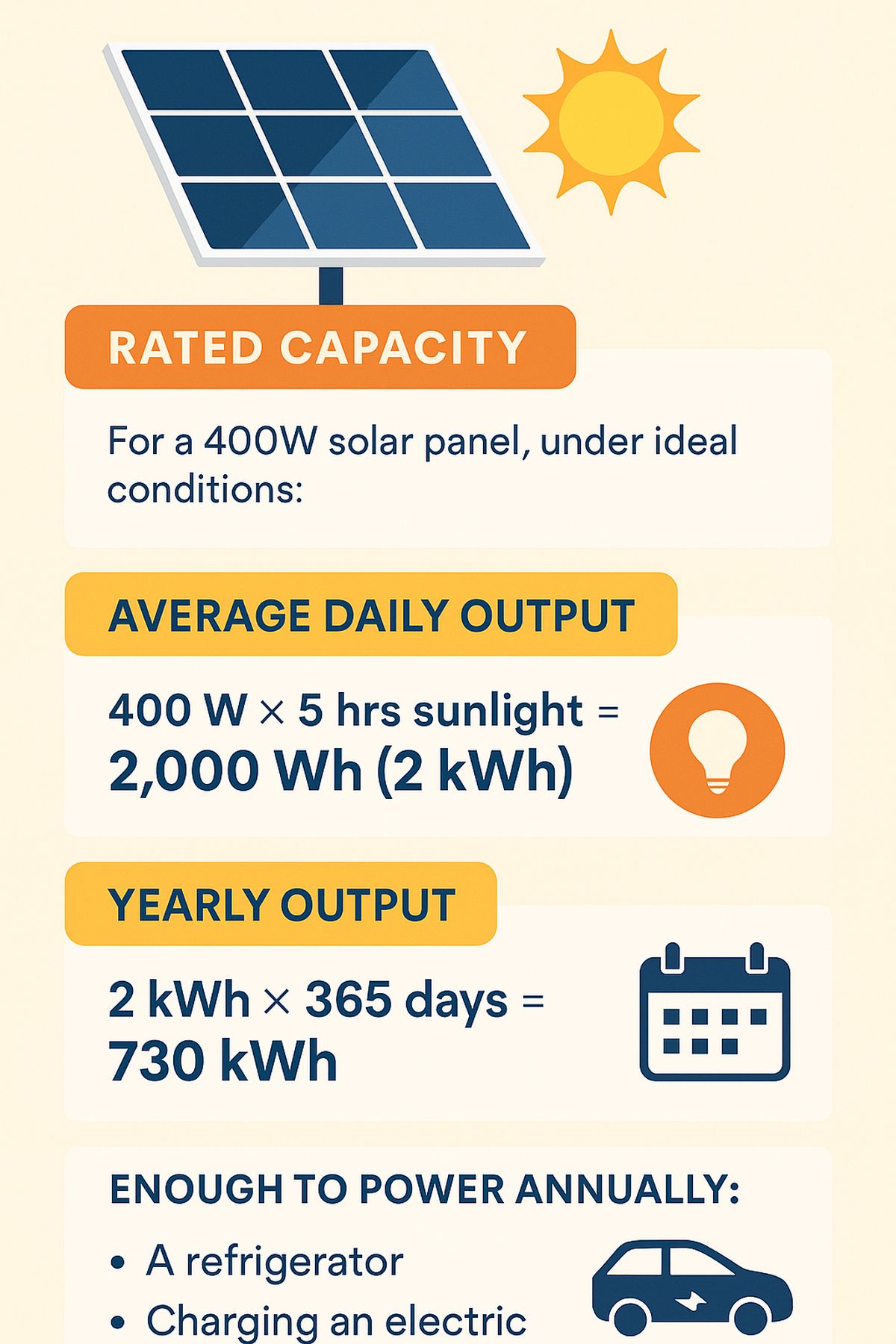
- This means that, under ideal conditions, a 400W solar panel produces 400 watts of electricity per hour of full sun.
Average Daily Production
To calculate daily electricity generation:
Solar panel wattage × hours of sunlight = daily output
For example:
- A 400W panel in a location with 5 hours of peak sunlight per day generates:
400W × 5 = 2,000Wh (2 kWh) per day
So, one 400W panel produces about 2 kWh per day in average conditions.
Yearly Production
Multiply daily output by 365 to estimate annual generation:
- 2 kWh/day × 365 = ~730 kWh per year
That’s enough to power:
- A refrigerator for a year, or
- Charging an electric car for ~2,000 miles.
Key Factors That Affect Output
- Sunlight Hours – Areas like Arizona or Australia get more solar energy than northern Europe.
- Panel Angle & Orientation – South-facing panels (in the northern hemisphere) perform best.
- Temperature – Solar panels work less efficiently in very hot conditions.
- Shading – Even partial shade (trees, chimneys) can reduce output significantly.
- Panel Efficiency – Modern panels are 18–22% efficient; higher efficiency = more output.
Example: How Many Panels to Power a Home?
The average U.S. household uses about 10,000–12,000 kWh per year.
- With one panel producing ~730 kWh per year, you’d need about 14–16 panels (400W each) to cover that usage.
Final Thoughts
A solar panel’s electricity output varies depending on size, location, and conditions — but as a rule of thumb:
- 1 standard residential solar panel = ~2 kWh per day = ~730 kWh per year.
By scaling up the number of panels, homeowners can offset a significant portion (or even all) of their electricity use with clean solar power.
Leave a Reply