
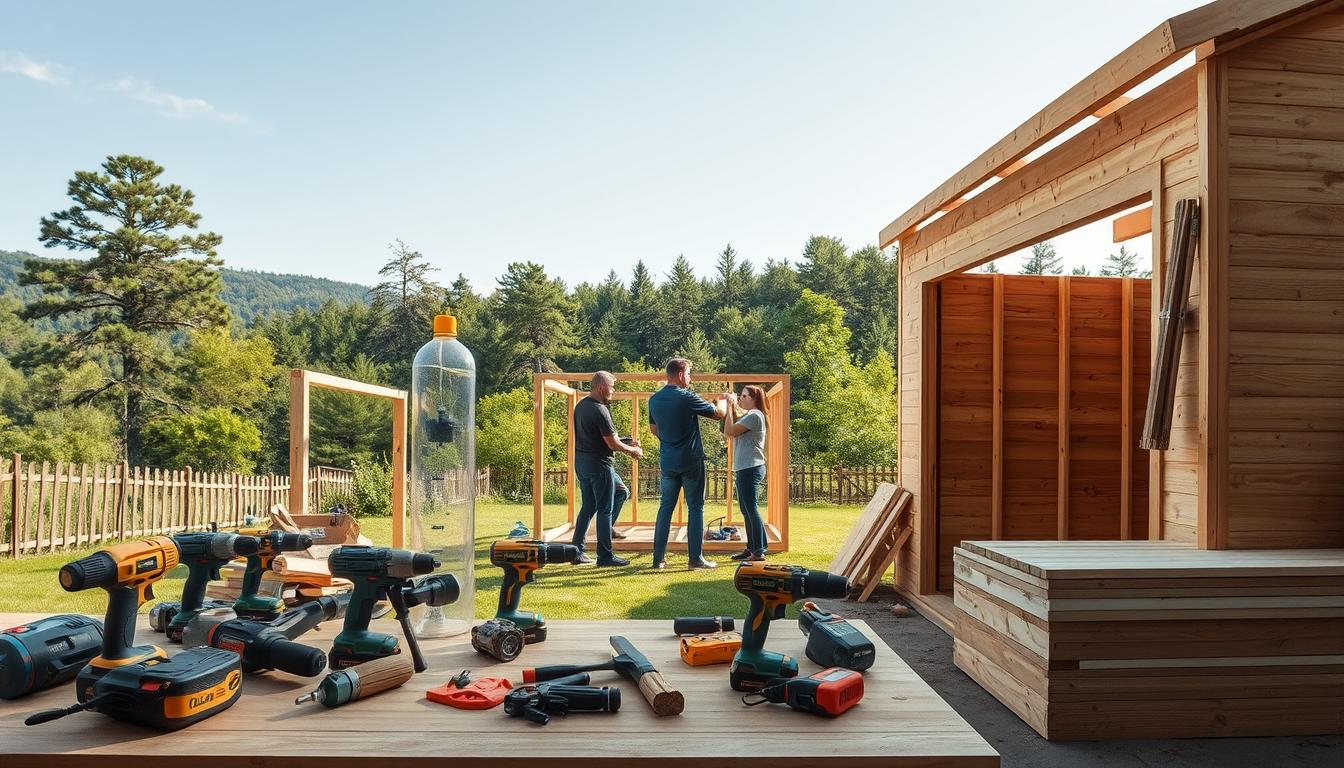
,Welcome to a friendly, step-by-step guide to help you plan a confident backyard project. This introduction sets expectations and outlines clear instructions so you can move from idea to finished building without feeling overwhelmed.
We cover how smart design choices using common 8-foot dimensions cut waste and save money. You will learn what to check first—site, permits, and basic tools—so you avoid costly delays.
Follow a simple build sequence that walks you through base and floor, walls and openings, roof framing, and finishing touches. Practical tips from real builds show where to invest for longevity and where you can save without hurting performance.
This guide helps you match the project to your backyard goals, whether you need storage or a flexible space for hobbies or a compact office. Read on to start with a clear plan and the right confidence.
Key Takeaways
- Start with site checks and local permits to avoid surprises.
- Use 8-foot module design to minimize cuts and waste.
- Keep a checklist of tools and materials before you begin.
- Follow the build order: base, walls, roof, trim, then interior.
- Check square, level, and plumb at each stage for faster installs.
Before You Start: Local regulations, permits, and calling 811 in the United States
Start by confirming local codes and permit triggers to avoid costly halts later. Many U.S. cities treat small accessory structures differently, and a quick check can save time and money.
Accessory structure thresholds
Review your municipality’s limits for area and height. In many places, an 8x8x8-foot example (about 64 square feet) stays under common permit thresholds.
Make sure whether power or plumbing will change your permit needs; adding wiring often requires an inspection and a permit.
Mark utilities and pick a compliant spot
- Call 811 before digging so buried utilities get marked—this is free and often required.
- Map setbacks, easements, drainage, and HOA rules to avoid conflicts with neighbors.
- Check frost-depth footings and tie-down rules for wind or seismic areas.
| Item | Typical limit | Why it matters |
|---|---|---|
| Maximum area | ≤ 120 sq ft | Avoids permit in many cities |
| Maximum height | ≈ 8 feet | Keeps structure within accessory rules |
| Wiring or plumbing | Often triggers permit | Requires inspections and approvals |
Document approvals and site plans. Note how a taller back wall or raised base can push your project over allowed limits. Plan delivery and staging so trucks do not harm the ground or marked utilities.
Design and budget: Shed size, use-cases, and cost-saving decisions
Smart sizing and clear goals keep costs down. Start by matching your footprint to standard 8-foot sheet goods and lumber so cuts and offcuts stay minimal.

Choose a primary use first. Decide if the space is mainly for storage, a garden workspace, or a hobby room. This choice drives door placement, windows, and outlet planning.
Optimizing dimensions
Pick common modules like 8×8, 10×12, or 12×16 to reduce waste and speed framing. One builder aimed for an 8×8 to match 8-foot materials; budgeted about $1,000 but spent roughly $1,200 after accounting for a sloped lot and a few upgrades.
Scope, materials, and time expectations
- Separate must-haves from nice-to-haves so the budget focuses on structure and weatherproofing.
- Price materials early; slopes add costs for piers or risers.
- Plan for pressure-treated base framing and quality underlayment to lower maintenance later.
- Estimate several weekends for a first-timer and rent specialty tools to save time.
Make sure aisles and headroom work for your intended storage and future needs. Add blocking for shelves and plan door sizes now so you don’t tear things down later.
Tools and materials checklist for building a shed that lasts
Collecting the right tools and materials up front saves time and prevents costly trips mid-build. Start with a short, practical list so the project flows and quality holds up for years.
Essential tools
- Core power tools: circular saw with tilting base, corded drill for holes, and a cordless driver for fasteners.
- Layout and measuring: framing square, chalk line, tape measure, and a long level to keep frames square and plumb.
- Site work: shovel, pick mattock, tamper, and rubber mallet to prep the ground and set piers or block pads.
- Hand tools: hammer, utility knife, and a clamp or two for assembly and trim work.
Materials and small extras
Structural material should include pressure-treated 2x6s for the floor and 2x4s for studs and rafters. Use 23/32″ T&G OSB for a stiff floor and 7/16″ OSB for roof sheathing.
“Choose factory-squared siding panels like SmartSide to speed squaring and reduce trim work.”
- Fasteners: exterior-grade screws, galvanized nails, 3″ framing screws, lag bolts, and joist hanger nails.
- Roof and exterior: roofing felt, drip edge, architectural shingles (or corrugated metal), roofing cement, Dynaflex 230 caulk, primer, and paint.
- Extras: hinges, door hardware, deck/floor coating, and landscape blocks or pier blocks for the base.
Final tip: Make a complete shopping list, stage materials off the ground, and double-check quantities. A good prep list keeps the build tight, weatherproof, and ready to use as an organized backyard workspace or storage shed.
Site prep and base options: Blocks, pier foundations, or concrete slab
A stable base starts with careful grading and simple blocking to keep your project square and dry. Clear turf, strip high spots, and compact the soil with a tamper before you place any supports.

Leveling, landscaping blocks, and pier grid spacing
Level the ground with a spade and tamper so the pad is firm. For small footprints, use landscaping blocks (for example, 12″x8″ garden blocks) at corners and midpoints.
Use a deck pier grid that matches load and span. A 12×8 base often uses piers spaced 6 feet one way and 4 feet the other. Insert each pier at least 1 inch into the ground for wind resistance.
When to choose a reinforced platform or slab on grade
On sloped sites, bury blocks on the high side and use pier blocks with risers on the low side. This avoids heavy excavation while keeping the platform level.
Consider a concrete slab in high-wind or seismic zones or where water collects. A slab improves rigidity, moisture resistance, and gives more options to anchor a shed securely.
- Dry-fit a temporary frame and measure diagonals until both match.
- Plan drainage: slope soil away and add gravel beneath blocks or slab.
- Call 811 and mark utilities before digging or placing heavy equipment.
| Item | Example | Why it matters |
|---|---|---|
| Pier spacing | 6′ x 4′ | Supports a 12×8 area without excess deflection |
| Block size | 12″x8″ | Easy to level at corners and mid-spans |
| Embedment | ≈1 inch | Resists uplift in wind |
Floor framing: Strong, square, and sag-free
Start floor framing by laying a stiff, square perimeter so the rest of the project aligns easily.
Use pressure-treated 2×6 for rim joists and all joists. Double the outer rim boards for a rigid perimeter that resists racking and supports wall loads.
Rim, joists, hangers, and blocking
Lay out joists at 16 inches on center, the same practice used on many small deck frames. Install galvanized joist hangers at each bearing with the correct hanger nails for a code-appropriate connection.
Add mid-span blocking between joists to support sheathing seams and stop joist twist under changing loads. Pre-drill and use lag bolts where the frame ties to risers and apply landscaping adhesive where the frame bears on blocks.
Tongue-and-groove sheathing and fastening
Use 23/32″ T&G OSB for a solid, sag-free floor. Fasten panels with 1-1/2″ exterior screws about every 8 inches along joists. Trim any overhanging tongue flush so panel edges are fully supported.
- Make sure the frame is square by matching diagonals before sheathing.
- Re-check level after the first panel and shim small discrepancies now to keep walls plumb later.
- Seal cut ends and keep PT lumber off wet ground to extend life.
| Item | Spec | Why it matters |
|---|---|---|
| Joist spacing | 16 inches O.C. | Standard load spacing for stiff floors |
| Rim & joists | PT 2×6 (double outer rim) | Prevents racking and supports wall loads |
| Sheathing | 23/32″ T&G OSB, 1-1/2″ screws @ ~8″ | Squeak-free, rigid floor assembly |
| Bearings | Landscaping adhesive + lag bolts | Secure frame to blocks and risers |
DIY shed construction: Framing end walls, side walls, and squaring panels
Begin by framing both end walls full-width on the platform. Build the side wall top and bottom plates to fit snugly between those end walls so corners tie tightly. Label each wall and mark orientation before you skin or lift.
Use 2×4 studs at 24 inches on center for typical small backyard builds. That spacing saves lumber and still gives good support for sheathing and siding.
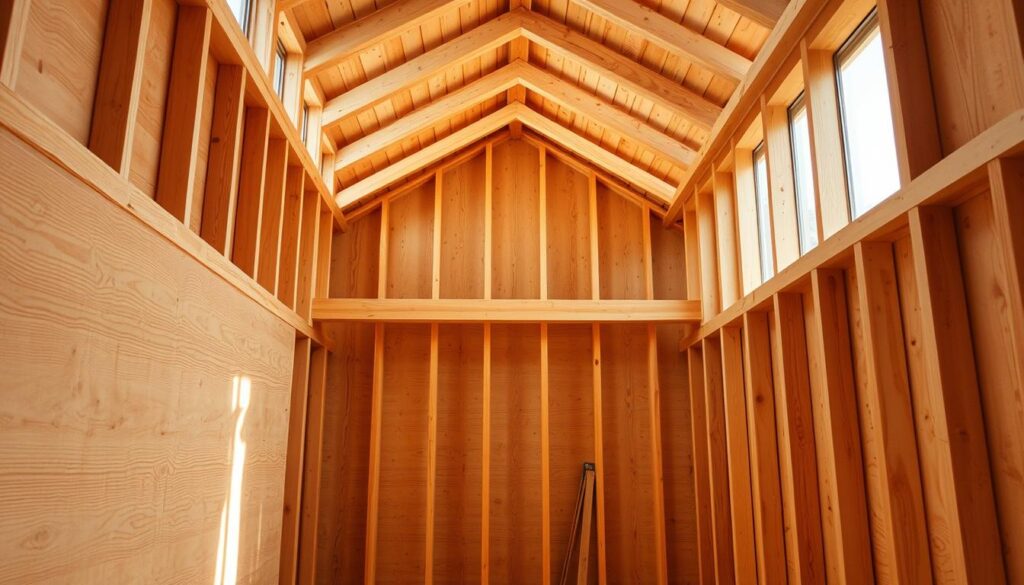
Stud spacing, back wall and side wall layout, and panel overhangs
Cut side wall plates shorter by about 3-1/2 inches at each end so the side walls fit neatly between full-width end walls. Lay out window and door openings on the framing before you add panels to avoid cutting into studs.
Make sure seams fall over studs and align vertical grooves around the building for a tidy finish. Pre-skin frames while flat on the floor to speed work and keep everything square.
Using factory-squared siding to pull frames into alignment
Fasten factory-squared siding panels to the flat frames. Let the panel bottoms overhang slightly to cover the floor rim; this improves weather protection and gives a clean edge.
- Tack panels lightly, check diagonals for squareness, then drive final fasteners.
- Dry-fit corner mating of end walls and side walls to confirm overhangs conceal framing at joints.
- Store completed wall sections on level blocking to prevent twist before raising.
| Item | Spec | Why it matters |
|---|---|---|
| Stud spacing | 24″ O.C. | Balances material cost and framing strength |
| End walls | Full width on platform | Makes side walls fit snugly for tight corners |
| Siding overhang | Bottom overhangs rim | Protects floor edge and trims neatly |
Doors and windows: Framing openings the right way
Plan door and window openings around traffic flow and usable wall space before you fasten plates. Proper layout saves time and keeps the back wall neat for storage and shelving.
Header planning: Size headers to span the clear opening and carry loads above. Use doubled or LVL headers for wider openings and add trimmers on each side to transfer weight to the floor frame.
Cut-out reuse, sheathing, and sequencing
Centering a door between studs simplifies framing and gives a clean nailing surface for trim. Make sure to leave the door sheathing in place until all walls are raised and fastened. This keeps the wall rigid while you lift and align sections.
After walls are secured, cut the door panel free with a reciprocating saw and remove the bottom sill. One builder saved the cut-out and built a matching door from it so siding lines and color matched perfectly.
Vent and weather details
Add vents high on a non-windowed side to promote cross-ventilation and reduce trapped moisture. Position vents away from prevailing winds and use screened vents to keep pests out.
Use flashing tape and drip caps over windows and top trim. Pre-drill hinge and latch blocking so hardware bites into solid wood and operates smoothly.
“Leave sheathing intact until walls are tied into the floor; it stabilizes panels and simplifies alignment.”
| Item | Recommendation | Why it matters |
|---|---|---|
| Header size | Doubled 2×10 or LVL for >36 inches | Transfers load and prevents sag |
| Door sequencing | Keep sheathing until walls tied; cut last | Keeps wall rigid during installation |
| Vent placement | High on non-windowed wall | Promotes airflow, reduces moisture |
| Thresholds & ramps | Slope away to ground grade | Sheds water and eases access |
Raise and tie the walls: Fastening to the floor and at the corners
Put the back wall in place first to create a true plane for the side walls to meet. Anchor it by driving exterior-rated screws through the sheathing into the rim and joists so the base holds fast.
Raise each side wall and butt it tightly to the back wall. Make sure corners are flush and square before you drive corner screws; this keeps the building true and reduces trim gaps later.
From inside, tie corners by screwing through the side wall framing into the end wall framing. This gives strong, hidden connections that resist racking.

Fasten along the base where siding overlaps the floor rim to seal and stiffen the joint. Use temporary braces to hold walls plumb until roof framing locks everything.
- Raise the front wall last and verify alignment with the side walls.
- Check diagonals across top plates to confirm the box is square.
- Cut the door opening free only after all walls are secured and remove the bottom sill to form the threshold.
Add extra screws at corners and near door openings, clean the work area, and stage trusses or rafters for the next step.
Roof framing: Trusses, rafters, and overhangs for better weather protection
Build trusses on a flat platform first; this keeps angles uniform and speeds the roof layout. Assemble five identical trusses for an 8-foot span, using repeatable 22.5-degree cuts so each joint matches.
Lay trusses at 24 inches on center and align them over wall studs so loads transfer straight to the frame below. Pre-cut identical webs and gussets to speed assembly and reduce mistakes.
Include modest overhangs at eaves and sides to shield siding and doors from rain and sun. For lean-to roofs, set the back wall lower than the front to create the slope and improve drainage.
Make sure the layout is square: snap reference lines, place the first sheathing panel perfectly, then stagger seams. Use 7/16″ OSB for decking and fasten with exterior screws about every 8 inches into the truss top chords.
Add 7-inch OSB strips where needed to complete roof depth. Install aluminum drip edge at the eaves first, then at rakes, to protect panel edges and direct water into the roof system.
- Check each truss plumb before sheathing to avoid wavy roof lines.
- Vent at the eaves and add gable vents if your climate benefits from extra airflow.
Roofing choices: Tar paper, shingles, or corrugated metal
The top layer does more than keep out rain; it controls heat, ventilation, and the finished exterior look.
Underlayment first: roll from eave to ridge, overlapping each course so water sheds downhill without tracking into seams. Install aluminum drip edge at eaves and rakes to protect sheathing and guide water away from walls.
Architectural shingles give a classic, durable cover. Follow the manufacturer nailing pattern and exposure lines. Stagger joints, use starter strips at the eave, and flash any penetrations thoroughly to avoid leaks.
For a lighter, modern option, use corrugated metal panels. Align panels square to the eave, overlap per the spec, and fasten with gasketed screws at ridges. Add ridge vents or gable vents to manage heat and moisture.
- Consider ice & water shield in eaves and valleys for snowy climates.
- Color-match shingles or panels to the house to lift curb appeal.
- Clean debris and check for proud fasteners before calling the roof complete.
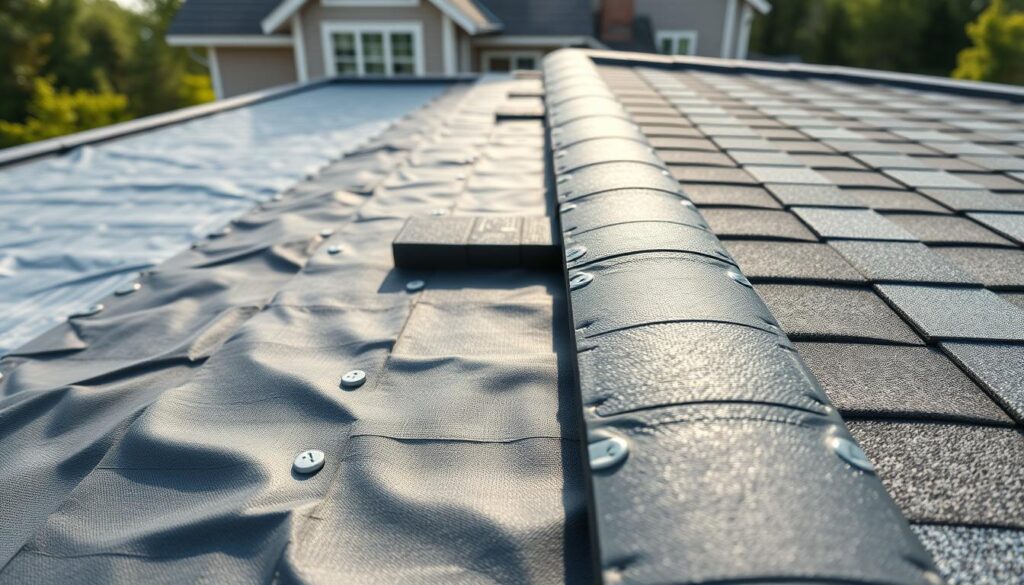
Make sure ventilation and flashing are resolved before finishing—this protects the building and keeps the exterior looking sharp for years.
Exterior finishing: Trim, caulk, siding, and paint for long-term durability
Finishing the outside well protects the building and makes it look deliberate. Thoughtful trim and sealant choices keep moisture out and simplify future maintenance.
Corner and window trim, sealing edges, and color ideas that pop
Install roof, corner, and window trim to protect panel edges and give crisp, architectural lines. One common approach uses actual 2x4s for roof trim to create a substantial, finished look.
Pre-paint trim boards before fastening to cut ladder time and speed the job. Fasten trim with 1″ staples or finish nails, then fill holes with exterior putty and sand smooth for a professional surface.
Caulk all joints—vertical seams, trim abutments, and any penetrations—using a quality, paintable caulk like Dynaflex 230. Back-prime cut ends of trim and siding where possible to resist moisture and swelling.
- Align trim reveals consistently around doors and windows for tidy sight lines.
- Add a simple drip cap above openings to deflect water away from joints.
- Plan capillary breaks at bottom edges; leave small, even gaps per manufacturer guidance.
Finish with a high-quality exterior paint (for example, Behr) in a color that complements your house. A rich body color with bright trim brings contrast, while a subtle monochrome keeps a modern, low-key look. Make sure to schedule painting on a dry, mild day and follow recoat times for best adhesion.
Build and hang the shed door: Hardware, hinges, and weather seals
Installing the door well finishes the project and protects what’s inside. Start by reusing the cut-out siding panel as a door slab so the exterior lines and color match perfectly. Keep the wall sheathing intact until all walls are tied to the floor, then cut the panel free and remove the sill to form the threshold.

Clearances, swing, and security considerations for high-traffic use
Choose heavy-duty hinges sized for the door’s weight — strap or butt hinges work well for frequent use. Fasten hinge screws into solid blocking or the door frame to avoid pullout over time.
- Leave even clearances (about 1/8–3/16 inches) on all sides for smooth operation during seasonal movement.
- Add a threshold or sweep and compressible weatherstripping to seal gaps against wind, rain, and pests.
- Position latches and locks into reinforced framing or added blocking for reliable security.
- Confirm swing direction and arc so the door won’t hit ramps, fences, or stored items.
- For double doors, use cane bolts or flush bolts to secure the passive leaf and reduce racking.
“Prime and paint all door edges before installation to reduce moisture absorption and keep the finish lasting longer.”
| Task | Recommendation | Why it matters |
|---|---|---|
| Door slab | Reuse wall cut-out | Perfect siding match, saves finishing work |
| Hinges | Heavy-duty strap or butt, corrosion-resistant | Handles traffic and outdoor exposure |
| Clearance | 1/8–3/16 inches | Allows seasonal movement without binding |
| Sealing | Threshold, sweep, compressible weatherstrip | Keeps out water, wind, and critters |
| Locks | Mount into blocking or studs | Prevents hardware failure and improves security |
Final check: use corrosion-resistant hardware in coastal or humid areas and test door operation after a day of weather to confirm seals and hinge alignment. Make sure the door closes smoothly and the latch engages cleanly.
Interior fit-out: Shelves, tool holders, ramps, and storage layouts
Think in vertical layers—use wall space first, then floor—so the interior feels roomy and organized. Plan zones for gardening, bike parking, and a small work area before you hang anything. A few smart choices free up walking paths and make the place simple to use.
Wall-mounted shelving to save floor space
Mount shelves to studs with ledger boards or heavy brackets so floor space stays open. Use adjustable shelving standards to reconfigure as items change with the seasons.
Garden tools, bikes, and PVC hangers to organize stuff
Store garden tools with 2″ PVC hangers cut into short loops; they grip handles, resist weather, and are cheap to swap out. Install bike hooks or a wall rack to lift bikes off the floor and reclaim square footage.
- Mount shelves to studs with a ledger or brackets to keep pathways clear.
- Use adjustable standards so storage adapts to new items.
- Make PVC hangers for garden tools and label each spot by use.
- Add a textured ramp at the door for mowers and bins to roll in safely.
- Keep frequent tools at arm height and heavy gear low for safety.
Group items by task and label bins so everything returns to its spot. A pegboard or slatwall near the workbench keeps hand tools visible and ready. These small fits make a small shed feel much larger and more useful.
Protect the floor: Waterproof coatings and heavy-use finishes
A quality coating turns the floor into a durable, water-resistant surface that stands up to mud, spills, and heavy gear.

Clean and lightly sand the subfloor first. Make sure the surface is dry and free of dust before you begin. Vacuum and wipe with a damp rag if needed.
Roll on a product like Rust-Oleum 4x Deck Cover. One build used a gallon to apply two heavy coats and achieved a reliable, waterproof finish. Allow proper dry time between coats for best adhesion and wear resistance.
- Use coatings rated for OSB or plywood and follow manufacturer guidance on primers and porosity.
- Add grit for slip resistance where wheels or wet shoes are common.
- Run the coating slightly up the wall base to form a shallow pan that contains minor spills.
Protect high-traffic zones with removable mats to absorb wear where mower wheels and toolboxes turn. Recoat on a maintenance cycle based on visible wear; quick touch-ups save time and prevent bigger repairs.
“A durable floor finish keeps the interior usable and reduces long-term repairs.”
Choose a shed plan size and style: Storage, garden, office, and garage options
Picking the right size and look up front saves time and money later. Start by matching the plan to how you will use the space and what must fit through the doors.
Compact storage options
Sizes like 4×6, 6×8, 8×10, 8×12, and 10×10 are ideal for tight yards. They give tidy storage for garden tools, bins, and seasonal gear without taking much space.
Mid-size garden and mixed-use
Consider 10×12, 10×14, 10×16, 12×12, or 12×16 when you want bench space, shelving, and room to pot plants or store bigger tools. These sizes balance storage and workspace well.
Roof styles, doors, and special features
Lean-to roofs offer a modern look and simpler framing. Gable roofs give a classic look and extra attic space for seasonal storage. For rolling equipment, pick wide or double doors (for example, a 64″ opening) and add a ramp.
Large workspace and vehicle storage
For garages or workshops, move up to 12×20, 12×24, 16×20, or 24×24. These plans prioritize clear floor space, tall sidewalls, and big openings for ATVs, mowers, or small vehicles.
- Office option: a 10×12 plan with three windows brings light for comfortable work.
- Garage-style: 12×16 or 12×20 on a reinforced platform handles tools and vehicles.
- Match roof style to your home: gable for traditional yards, lean-to for contemporary looks.
Quick checklist before you buy plans: confirm wall height in feet, door type and size, roof pitch, and whether the platform needs reinforcement for heavy loads.
You’re ready to build: Next steps to break ground on your backyard shed
Before the first post goes in, confirm a short checklist so the whole build flows without surprises.
Step 1: Confirm local thresholds for area and height (for example, ≤120 sq ft and ≈8 ft tall) and call 811 to mark utilities.
Step 2: Prep the lot—strip sod, level and compact the ground, and choose a base: blocks, deck piers on a 6′ x 4′ grid, or a slab depending on soil.
Step 3: Frame a rigid floor with pressure-treated 2x6s, joists 16″ on center, mid-span blocking, and 23/32″ T&G OSB fastened about every 8″.
Step 4: Build walls at 24″ on center on the floor and pre-skin with factory-squared panels that overhang to protect the rim.
Step 5: Raise the back wall first, tie corners from inside, fasten to the base, then set trusses or rafters at 24″ spacing and square before sheathing the roof.
Step 6: Install underlayment and drip edge, then finish with shingles or corrugated metal. Add trim, caulk, paint, and weather seals.
Final step: Hang the door, set clearances, fit shelves and tool holders, and coat the floor for long-lasting use. These instructions give you the sequence, tools, and timing to start the project with confidence and finish on time.
Leave a Reply